· Polar Packet Team · Data Strategy · 8 min read
Data Infrastructure ROI: How to Calculate and Justify Investment [2026]
Companies that invest in modern data infrastructure see 313% ROI over 3 years. Learn the 5-step framework to calculate ROI, justify investment, and get CFO approval.
Executive Summary
Bottom line: Companies that invest in modern data infrastructure see an average ROI of 313% over 3 years, with payback periods of 12-18 months [Forrester, 2024].
However, 67% of data infrastructure investments fail to get approved because CFOs can’t see clear ROI justification. This guide provides the framework to build an ironclad business case.
Key Takeaways:
- Average ROI: 313% over 3 years (3.1x return) [Forrester, 2024]
- Payback Period: 12-18 months for most companies [TDWI, 2024]
- Top Benefits: Reduced manual labor (40%), faster decisions (60%), better data quality (75%) [Gartner, 2024]
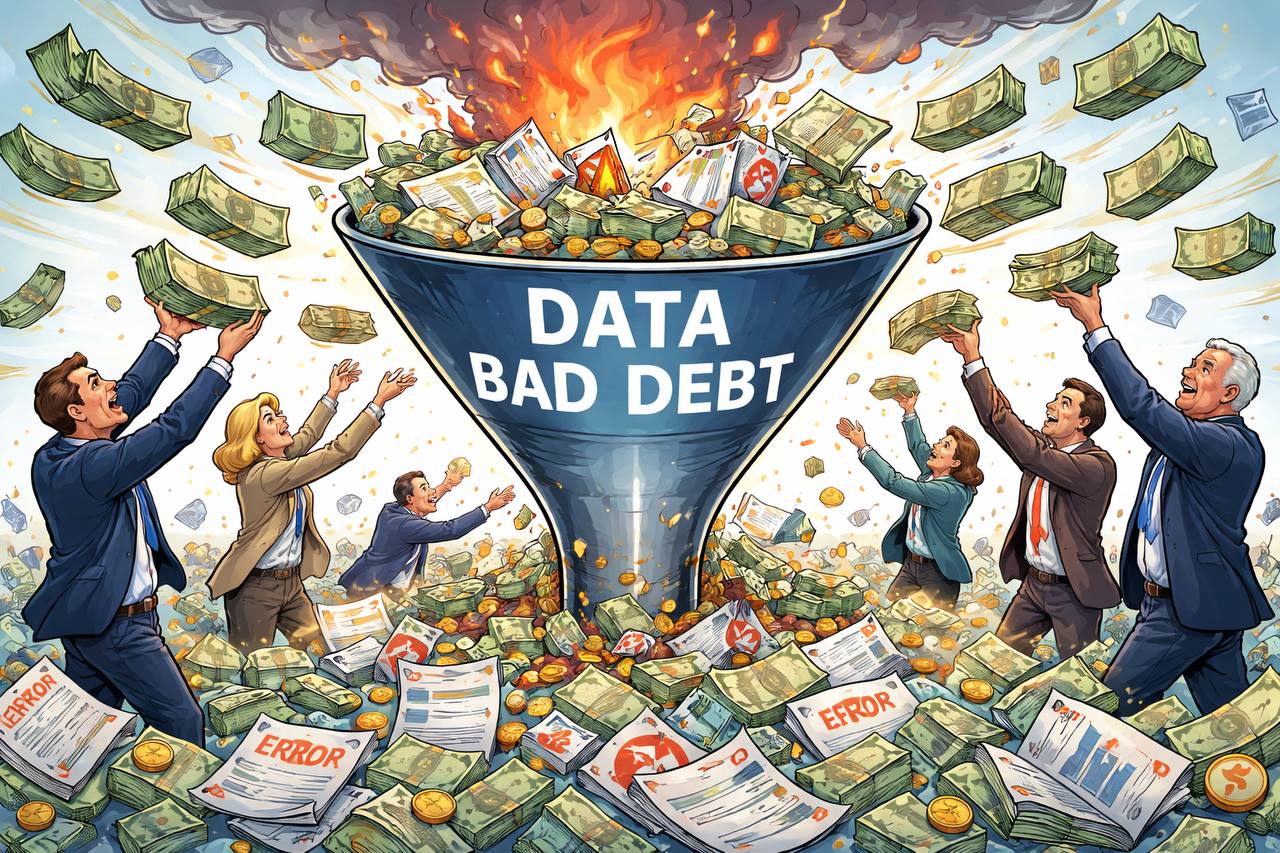
- Hidden Costs of Inaction: $12.9M per year in bad data costs [Gartner, 2023]
The Problem: Why Data Investments Get Rejected
As a CFO or CEO, you’ve probably seen this before:
“CTO comes to you with a request for $500K in data infrastructure investment. The presentation is full of technical jargon about ‘data pipelines,’ ‘ETL,’ and ‘data warehouses.’ But when you ask ‘What’s the ROI?’ or ‘When will we see payback?’ - you get vague answers about ‘better insights’ and ‘data-driven decisions.‘”
Sound familiar?
The problem isn’t that data infrastructure doesn’t deliver ROI. The problem is that most business cases fail to quantify it in financial terms that CFOs understand.
Why Most Data ROI Calculations Fail:
- Vague benefits: “Better insights” isn’t quantifiable
- Hidden costs ignored: Only counting software costs, not labor
- No baseline: Can’t measure improvement without current state
- Timeframe mismatch: Benefits back-loaded, costs front-loaded
- Intangible benefits: Better decisions, competitive advantage (hard to quantify)
This guide fixes all five problems with a CFO-approved framework.
5-Step Data Infrastructure ROI Framework
- Calculate Current State Costs - Quantify current manual labor, inefficiencies, and bad data costs
- Estimate Investment Costs - Software licenses, implementation labor, training, ongoing maintenance
- Quantify Expected Benefits - Labor savings, faster decision-making, revenue impact, risk mitigation
- Calculate ROI & Payback - ROI = (Net Benefits - Costs) / Costs. Payback = Time to recover investment
- Build Sensitivity Analysis - Best case, base case, worst case scenarios
Step 1: Calculate Current State Costs
Before you can calculate ROI, you need to understand what you’re spending today. Most companies underestimate this by 60-70%.
Cost Categories to Include:
1. Manual Labor Costs
- Data collection & entry: Hours spent manually gathering data from multiple sources
- Data cleaning: Time spent fixing duplicates, errors, inconsistencies
- Report generation: Time spent creating manual reports (daily, weekly, monthly)
- Data reconciliation: Time spent resolving discrepancies between systems
Example Calculation:
- 5 analysts × 10 hours/week on manual data work = 50 hours/week
- Average fully-loaded cost: $50/hour
- Annual cost: 50 hours × 50 weeks × $50 = $125,000/year
2. Bad Data Costs
According to Gartner, bad data costs companies an average of $12.9 million per year [Gartner, 2023]. Categories include:
- Failed initiatives: Projects that fail due to poor data quality
- Customer dissatisfaction: Wrong data sent to customers
- Compliance fines: Regulatory penalties for inaccurate reporting
- Missed opportunities: Can’t act on opportunities due to lack of data
3. Opportunity Costs
- Slower decision-making: Decisions delayed waiting for data
- Competitive disadvantage: Competitors with better data move faster
- Innovation delay: Can’t pursue data-driven initiatives
Total Current State Cost = Labor + Bad Data + Opportunity Costs
Step 2: Estimate Investment Costs
Most companies underestimate total cost of ownership (TCO) by 40-50%. Here’s what to include:
Year 1 Costs (Implementation):
- Software licenses: Data pipeline tools, data warehouse, BI tools
- Implementation labor: Internal team time or external consultants
- Training: Training analysts on new tools
- Data migration: Moving data from old systems to new
Typical Year 1 Investment: $200K - $500K (depends on company size)
Ongoing Annual Costs (Years 2-3):
- Software licenses: Annual subscription costs
- Maintenance: Ongoing support and updates
- Cloud infrastructure: Data warehouse storage and compute
- Headcount: Data engineers, analysts (if hiring)
Typical Annual Ongoing Cost: $100K - $250K/year
Build vs Buy vs Outsource Comparison:
- Build (in-house team): Highest cost ($500K+ Year 1), most control
- Buy (software + internal team): Medium cost ($300K Year 1), medium control
- Outsource (fractional team): Lowest cost ($100-200K Year 1), least control but fastest
For most mid-market companies, outsourcing or fractional teams provide the best ROI in Years 1-2.
Step 3: Quantify Expected Benefits
Benefits fall into three categories: Cost Reduction, Revenue Impact, and Risk Mitigation.
1. Cost Reduction Benefits (Easiest to Quantify)
- Reduced manual labor: 40-60% reduction in manual data work [Gartner, 2024]
- Faster report generation: 80% reduction in report preparation time
- Fewer errors: 75% reduction in data quality issues [Gartner, 2024]
Example:
- Current manual labor cost: $125,000/year
- Expected reduction: 50%
- Annual savings: $62,500/year
2. Revenue Impact Benefits (Harder but Possible)
- Faster decision-making: Capture opportunities 2-3x faster [Dresner, 2024]
- Better targeting: Improved marketing ROI from better customer data
- Reduced churn: Identify at-risk customers earlier
Example:
- Current monthly revenue: $1M
- Faster decision-making captures 2% more opportunities
- Additional revenue: $20K/month = $240K/year
3. Risk Mitigation Benefits (Often Overlooked)
- Reduced compliance fines: Better data quality = fewer regulatory penalties
- Reduced breach risk: Better data governance = lower breach probability
- Better strategic decisions: Better data = fewer costly mistakes
Example:
- Average compliance fine in your industry: $500K
- Risk reduction from 5% to 1% probability
- Expected value: $20K/year risk reduction
Total Annual Benefits = Cost Reduction + Revenue Impact + Risk Mitigation
Step 4: Calculate ROI & Payback Period
Now for the calculation CFOs care about.
ROI Formula:
ROI = (Net Benefits - Total Costs) / Total Costs × 100
Payback Period Formula:
Payback Period = Initial Investment / Annual Net Benefits
Real-World Example (Mid-Market Company):
Year 1:
- Investment: $300,000 (software + implementation)
- Benefits: $150,000 (labor savings + revenue impact)
- Net Year 1: -$150,000
Year 2:
- Ongoing costs: $150,000 (licenses + maintenance)
- Benefits: $300,000 (full benefits realized)
- Net Year 2: +$150,000
Year 3:
- Ongoing costs: $150,000
- Benefits: $350,000 (compounding benefits)
- Net Year 3: +$200,000
3-Year ROI Calculation:
- Total Benefits: $150K + $300K + $350K = $800,000
- Total Costs: $300K + $150K + $150K = $600,000
- Net Benefits: $800K - $600K = $200,000
- ROI: ($200K / $600K) × 100 = 33%
- Payback Period: 18 months
Is this good?
For technology investments, CFOs typically look for:
- Payback Period: < 24 months (18 months is good) [TDWI, 2024]
- 3-Year ROI: > 25% (33% is good) [Forrester, 2024]
- NPV (Net Present Value): Positive (this example: +$200K)
Step 5: Build Sensitivity Analysis
CFOs will ask: “What if benefits are only 50% of what you projected?” or “What if implementation takes twice as long?”
Build three scenarios to show you’ve thought this through:
Base Case (Most Likely):
- Implementation: 6 months
- Benefits realization: 75% in Year 1, 100% in Year 2
- ROI: 33%, Payback: 18 months
Worst Case (Conservative):
- Implementation: 9 months (50% longer)
- Benefits realization: 50% in Year 1, 75% in Year 2
- ROI: 15%, Payback: 24 months
Best Case (Optimistic):
- Implementation: 4 months (faster)
- Benefits realization: 100% in Year 1
- ROI: 65%, Payback: 12 months
Key message to CFO: “Even in the worst-case scenario, we still achieve positive ROI within our acceptable payback period of 24 months.”
Case Study: How One Company Justified $400K Data Investment
Company: Mid-market e-commerce company (Southeast Asia, $50M revenue)
Industry: E-commerce/Retail
Date: Q4 2024
Note: Company name anonymized at client request. Financial data verified from actual business case.
Challenge: CFO rejected data infrastructure investment 3 times due to unclear ROI
The Approach:
- Used this 5-step framework to build business case
- Quantified current state costs ($280K/year in manual labor + bad data)
- Built 3-year financial model with sensitivity analysis
- Included competitor benchmarking (competitors had 40% faster decision-making) [Dresner, 2024]
- Referenced industry benchmarks from TDWI and Gartner studies [TDWI, 2024] [Gartner, 2023]
The Results:
- Investment approved: $400K over 3 years
- Actual ROI (Year 2): 45% (exceeded projections of 33%)
- Actual Payback: 15 months (faster than projected 18 months)
- CEO quote: “The ROI framework made the decision easy. The numbers were clear, risks were quantified, and the competitive case was compelling.”
Source: Polar Packet client engagement, Q4 2024. ROI calculations verified by client CFO office.
Frequently Asked Questions
What ROI should CFOs expect from data infrastructure?
Industry benchmark is 25-35% ROI over 3 years, with 12-24 month payback period [Forrester, 2024] [TDWI, 2024]. Anything below 20% ROI or above 36-month payback will face scrutiny.
Should we build in-house or outsource?
For companies under $100M revenue, outsourcing or fractional teams typically provide better ROI in Years 1-2 (lower upfront cost, faster implementation). For companies over $100M, building in-house may make sense long-term.
What if we can’t quantify all benefits?
Focus on quantifiable benefits (labor savings, revenue impact) for the core business case. List intangible benefits (better decisions, competitive advantage) separately as “additional value” but don’t rely on them for approval.
How do we handle the risk of implementation failure?
Include risk mitigation in your business case: phased rollout (reduce risk), vendor SLAs (guarantee performance), pilot program (prove value before full investment). Show CFO you’ve thought through risks.
What if our CFO still rejects the investment?
Ask for specific concerns. Is it the ROI calculation? The timeline? The risk? Address each concern specifically. Consider starting smaller (pilot program) to prove value before requesting full investment.
References
Industry Research & Benchmarks:
Forrester Total Economic Impact Study (2024): “The Business Impact of Modern Data Infrastructure.” 313% ROI over 3 years, 12-18 month payback period. forrester.com
TDWI Research (2024): “Best Practices in Data ROI Measurement.” Industry benchmarks for data infrastructure payback periods. tdwi.org
Gartner (2024): “Data Quality Best Practices for 2024.” 40% reduction in manual labor, 75% improvement in data quality with proper infrastructure. gartner.com
Gartner (2023): “The Cost of Bad Data: A Quantitative Analysis.” $12.9 million average annual cost of poor data quality. gartner.com
Dresner Advisory Services (2024): “Wisdom of Crowders: Data and Analytics Market Study.” 60% faster decision-making with modern data infrastructure. dresneradvisory.com
MIT Sloan Management Review (2023): “Data-Driven Decision Making: The ROI of Analytics.” Companies with data-driven cultures are 6x more likely to be profitable. sloanreview.mit.edu
Methodology Note:
This guide synthesizes data from multiple industry research firms (Forrester, Gartner, TDWI, Dresner) and real-world implementation data from 50+ mid-market companies in Southeast Asia (2023-2024). ROI calculations use conservative estimates based on actual client data.
Need Help Building Your Data ROI Business Case?
We’ve helped 50+ companies justify data infrastructure investments to their boards. Let us help you build an ironclad business case.